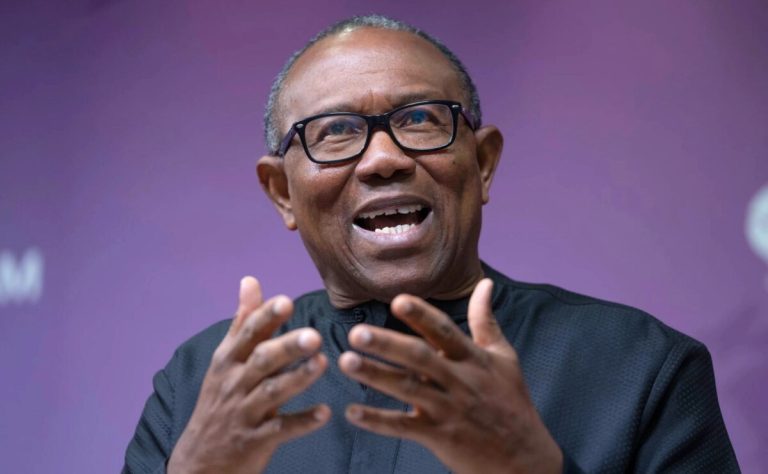


The expanding debt profile under Bola Tinubu’s administration has drawn criticism from former Labour Party presidential candidate Mr. Peter Obi, who has warned that Nigeria’s debt payment requirements are displacing investments in vital areas.
Obi made this claim in a message posted on his X Twitter on Monday with the heading, “Debt Servicing, Borrowing, and Nigeria’s Fiscal Priorities.”
He stated that Nigerians interested in the nation’s economic future and progress should be concerned about the Federal Government’s anticipated expenditure of roughly $11.6 billion on debt servicing.
He contends that borrowing is not intrinsically bad as long as it is handled carefully and directed toward profitable industries that may produce long-term financial gains.
Japan, the United States, the United Kingdom, the United Arab Emirates, Singapore, and Indonesia are just a few of the high-debt countries that Obi mentioned as investing borrowed money in infrastructure, healthcare, education, and innovation.
However, he contended that Nigeria’s circumstances are different as a sizable amount of prior borrowing was purportedly used for consumption with minimal discernible developmental impact.
The former governor of Anambra State further asserted that borrowing has continued at what he called a “rapid pace” and that a significant portion of the debt now being serviced was accrued during the Tinubu administration.
According to Obi, the budget included ₦2.46 trillion for health, ₦2.56 trillion for education, and ₦865 billion for poverty alleviation, for a total of roughly ₦5.885 trillion.
He pointed out that the total amount allotted to the sectors is about three times less than the debt servicing, which is anticipated to be between ₦17 trillion and ₦18 trillion depending on exchange rates.
Nigeria will spend over $11.6 billion on debt servicing, according to President Bola Ahmed Tinubu during his most recent international visit. This amount should worry anyone interested in the nation’s long-term economic growth.
When borrowing is prudent and used for profitable investments, there is nothing intrinsically wrong with it.
However, the situation in Nigeria is very different. In the past, a significant amount of borrowing has gone toward consumption, with few observable or long-term developmental results to support the amount of debt.
It’s also crucial to remember that while borrowing has continued at a notable rate, a sizable amount of the debt now being serviced was accrued during the Tinubu government.
In light of this, Nigeria’s 2026 budget allocates ₦2.46 trillion for health, ₦2.56 trillion for education, and ₦865 billion for poverty alleviation, for a total of almost ₦5.885 trillion for these three crucial areas. In contrast, the amount allotted to health, education, and social protection combined is about three times less than the $11.6 billion debt servicing (around ₦17–₦18 trillion, depending on exchange rate assumptions).
This disparity draws attention to a concerning budgetary reality where debt commitments are progressively displacing investments in human capital and poverty alleviation.
About The Author