
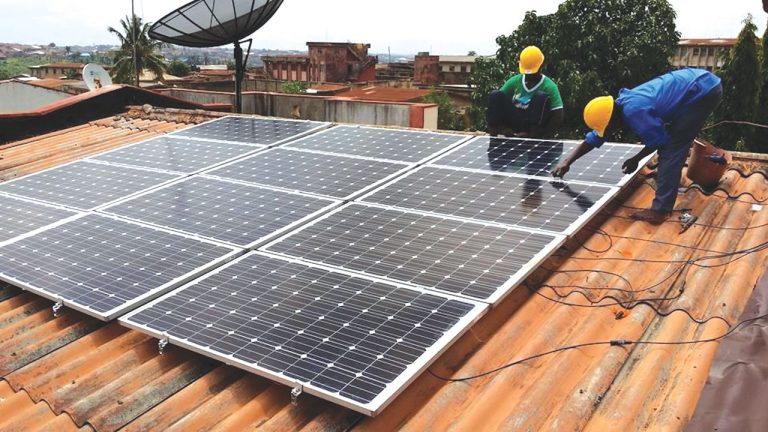


Lagos State Ministry of Housing authorities confronting a resident about solar panels installed on his home in a widely shared video on social media recently infuriated the state’s citizens.
Officials from the ministry’s monitoring and compliance unit were seen in the video requesting that the resident get permission and pay a fee before the installation could begin.
However, in response, the state government declared that only residents of its social housing estates are eligible for licenses and administrative costs for solar power systems, not private homeowners or tenants throughout the state.
The wrath of the populace is complex. Some people are furious that the government is pursuing taxpayers rather than thanking them for filling the void.
Others, however, cautioned that in a nation where power disruptions are common, such regulations would deter the use of renewable energy. This side of the debate maintains that the state administration only wants its people to be depressed and in the dark.
The resident misinterpreted the guideline, according to Wale Ajetunmobi, senior special adviser on media to Lagos State Governor Babajide Sanwo-Olu, who responded in an X post.
He claims that not all citizens are subject to the state’s solar installation fees.
He stated, “This development is true, but the man who made the video seems to be misinformed about the Lagos State Government’s guidelines for installing solar energy systems in social housing estates.”
He clarified that administrative expenses for modifications, such as the installation of solar power systems, are exclusively assessed to inhabitants of government-owned social housing estates.
According to Ajetunmobi, the obligation is related to the government’s duty as the estates’ facilities manager, pointing out that solar installations are seen as structural modifications, particularly when they impact shared areas or a building’s original design.
Before any further construction can be approved, “only residents living in government-owned social housing estates are charged administrative fees for alterations, such as the installation of a solar power system,” he stated.
“Any modification must go via the Ministry of Housing’s physical planning and survey divisions for approval, material compliance, and post-inspection checks.
Since those solar power systems are typically constructed by residents in shared spaces, the facility management (government) must authorize the change before any residents can move further.
The person in the video, he continued, is probably a tenant who rented one of the government-owned estates from the property owner and is not quite aware of the indemnity document’s contents.
He added that the resident did not get prior consent before starting installation and that the authorities in the video were from the ministry’s monitoring and compliance unit.
He noted that in the past, the government dealt with responsibilities resulting from unauthorized changes, such as roof damage and fire occurrences.
He probably lives in one of these Lagos state government-owned social housing complexes; otherwise, he wouldn’t have voiced worries about something that was explicitly stated in the indemnity agreement he signed prior to the government giving him the flat following purchase.
“Any estate occupant should simply ask the state government (facility manager) for permission before making any external changes.”
Unauthorized modifications to common property might subject the government to obligations implicating other residents, he continued.
Building structural modifications must be approved by the appropriate authorities in accordance with the Lagos State Urban and Regional Planning and Development Law.
authorities.
But what started out as a government rule governing the installation of solar panels on state-owned properties has turned into a heated public discussion about taxes, housing failure, governance, and the boundaries of state authority in a city facing increasing economic hardship.
In addition to denouncing the government’s move, locals are demanding that the law be repealed since they see it as commercializing survival.
For many Lagosians, the problem extends well beyond solar energy; they perceive it as an additional layer in what they characterize as an expanding system of levies, approvals, and costs placed on residents who are already compelled to provide for their own basic needs.
Some people think that although governments in affluent nations support the use of renewable energy, Lagosians are being charged extra just for trying to avoid darkness.
As tensions increased throughout the state and many were prepared to confront government officials, not even the government’s explanation could calm the populace.
Many locals maintain that the program is only in its “pilot phase” and may soon be extended to private estates and regular households throughout the state. They believe that by the time the government wants to expand it to private home owners, it will be too late if they do not act now.
Some people are concerned about why citizens who already supply their own water, energy, and security would have to pay the government to build solar systems, which are a natural gift to humanity.
“The state government has no right to sell God’s energy,” said Anthony Osewele, a businessman who lives in a private estate in Lagos’ Amuwo Odofin neighborhood.
“You wonder if people still have any conscience at all when they choose to claim the role of God.”
No one is allowed to sell solar energy that God has given them. We are discussing solar energy, which comes from the Sun and is a gift from God to humanity. The universe revolves around the sun. Therefore, I consider it to be wrong and the pinnacle of iniquity for anyone in a position of power to even consider charging citizens for the use of sunlight. This implies that they will eventually figure out a way to charge folks for simply breathing the air. In every way, this is unacceptable.
In some countries, the government supplies electricity to its people around-the-clock. However, in this case, the government creates darkness, making people’s lives miserable and brief.
Additionally, the government is there to make people’s suffering worse by taxing them when they try to improve their lives by providing alternatives. “This is terrible,” he said.
Marcellus Onah, a lawyer, further supports Osewele’s viewpoint by emphasizing that locals are adopting solar power as a need imposed on them by the failure of the public energy supply rather than as a luxury.
“People are purchasing solar because the government hasn’t been able to supply reliable electricity, which is the very minimum that any responsible government ought to give.
We supply our own water. We produce our own electricity. We repair the roads that surround us. The government still wants to tax us for attempting to survive in spite of all of this. It’s terrible and unacceptable,” he said.
Rowland Adebayo, an estate agent, bemoaned the fact that Lagosians are becoming more and more smothered by numerous taxes and levies without matching public services.
“Road parking fines have been implemented. Tenement rates are what they demand. There are new levies every day.
“If the government is acting morally, I don’t mind paying taxes.
However, it is illegal to demand payment for solar energy installation. He said, “It is like taxing sunlight, which is a free gift from God and we must resist.”
About The Author