
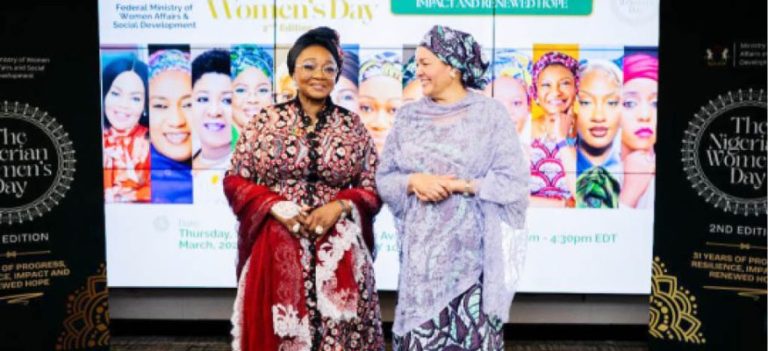


In an effort to strengthen gender equality and promote inclusive national development, the Federal Government of Nigeria has announced plans to increase focused interventions for women throughout the country in sectors like energy access, digital inclusion, agriculture, health, education, and leadership development. Speaking at the Nigerian Women’s Day celebration on the fringes of the 70th Session of the United Nations Commission on the Status of Women (CSW70) in New York, Minister of Women Affairs Imaan Sulaiman-Ibrahim revealed this.The Federal Ministry of Women Affairs and Social Development organized the event, which brought together international leaders, ministers, diplomats, gender advocates, and Nigerian diaspora members to talk about how to build family resilience and advance women’s empowerment. Amina J. Mohammed, the Deputy Secretary-General of the United Nations, was among the dignitaries in attendance. She joined Nigerian officials and other international stakeholders in discussing measures to promote women’s economic engagement and gender equality.Speaking at the “31 Years of Progress, Resilience, Impact and Renewed Hope” event, Sulaiman-Ibrahim described how the Federal Government is putting a comprehensive plan into action using the Renewed Hope Social Impact Interventions 774 (RH-SII-774) framework. She claims that the initiative’s programs on energy access, agriculture, digital inclusion, healthcare, protection, creativity and innovation, education, child development, and family resilience are intended to reach women throughout the nation’s 774 local government areas. She pointed out that empowering women requires more than just policy declarations; it also requires consistent funding and useful initiatives that can change lives on a large scale.According to her, “sustained investment, strong partnerships, and coordinated action are necessary to transform women’s lives at scale.” “More funding for women and girls is desperately needed, both nationally and internationally. Women’s empowerment is a development necessity, an economic plan, and a security policy rather than a social initiative.Additionally, the minister issued a six-point call to action asking governments, development partners, and civil society organizations to boost funding, improve cooperation, and expedite initiatives that support women’s growth. A fireside discussion between Sulaiman-Ibrahim and UN Deputy Secretary-General Amina Mohammed, which explored the relationship between Nigeria’s national gender policies and the global agenda for women’s empowerment, was one of the event’s highlights.In addition to discussing prospects for enhancing women’s leadership in governance, peacebuilding, and economic development, participants engaged the speakers on the main issues facing women and girls throughout Africa. Three high-level panel discussions on Global Leadership, Peace and Security for Social Impact, Women, Institutions and the Economy, and Positive Masculinity were also included in the event. The discussions covered topics such as women’s roles in international organizations, opportunities for economic development, and the significance of enlisting males as partners in the fight for gender justice. Aisha Abubakar Baju, Assistant Inspector-General of Police, Aminu Yusuf, Chairman of the National Population Commission, and Nkeiruka Onyejeocha, Minister of State for Labor and Productivity, were among the other notable attendees.Former Minister of Women Affairs Pauline Tallen, Country Director of ActionAid Nigeria Andrew Mamedu, Executive Secretary of the National Human Rights Commission of Nigeria Tony Ojukwu, and a number of government officials, leaders of civil society organizations, and Nigerians living abroad were also present.There were also artistic and cultural performances at the event. Laolu Senbanjo, a well-known Nigerian artist and human rights activist, gave a talk about how art can dispel stereotypes and spur social change. He used elaborate black-and-white designs in his trademark live body-painting presentation.The Nigerian Women’s Day event, according to its organizers, is a reflection of the nation’s dedication to putting women, children, and families at the center of economic policy and national development.They pointed out that Nigeria keeps pushing for more robust international cooperation to promote women’s empowerment and sustainable development by utilizing international forums like the Commission on the Status of Women.A
About The Author