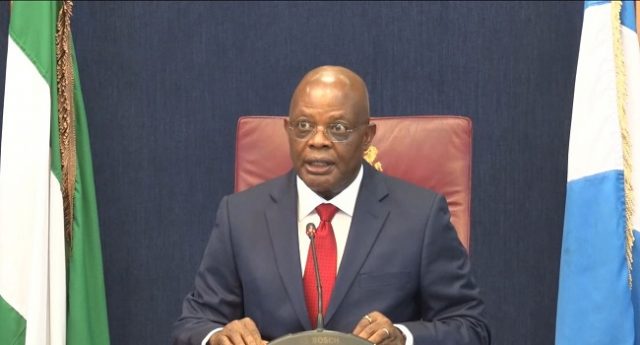


Marshall Stanley-Uwom, a former deputy speaker of the Rivers State House of Assembly, has petitioned the Federal High Court in Abuja to prevent the federal government from giving funds to local government councils in Rivers State, which are run by Vice Admiral Ibok-Ete Ibas (Rtd), the state’s sole administrator.
In a lawsuit filed on April 24 under the suit number FHC/ABJ/CS/797/2025, the plaintiff contended that the sole administrator in Rivers State is not legally permitted to designate unelected officials as caretakers for local government councils in accordance with Section 7(1) of the 1999 Constitution (as amended) and a ruling by the Supreme Court.
President Bola Tinubu, the National Assembly, the Senate, the Senate President, the President of the Senate, the Speaker of the House of Representatives, Vice Admiral Ibas (Rtd), the Central Bank of Nigeria, the Accountant-General of the Federation, and the Federation Account Allocation Committee were all named as first through tenth defendants by the plaintiff in the lawsuit.
In the Sioux case, Stanley-Uwom (plaintiff) argued that the CBN, Accountant-General, and Federation Account Allocation Committee were not allowed to distribute funds intended for local government councils in Rivers State to unelected officials chosen by the sole administrator due to Section 7(1) of the Constitution, the Electoral Act, and the Supreme Court’s ruling.
The plaintiff further stated that the “Constitution requires the government of each tier (Federal, State, and Local Government) to be democratically elected.”
He further added that for Local Government Areas, specific provision for their governance is made in Section 7(1) of the 1999 Constitution, which provides that “Local government shall be by democratically elected Local Government Councils.”
He further argued, stating, “The Constitution, having prescribed that its government shall be by democratically elected Local Government Councils, cannot be governed by any other body or means. Therefore, it cannot be governed or administered by the Federal Government, State Government, Governor of a State, Local Government Caretaker Committee, Interim Local Government Council, Administrator, Head of Local Government, or by whatever name called, or by any other state agency or other body.”
The plaintiff further claims that the 1999 Constitution prohibits local government areas from being governed by anything other than a democratically elected council, and that doing so would be unlawful, unconstitutional, and ineffective.
The plaintiff, among others, requested the following reliefs: “A declaration that the state of emergency proclaimed in Rivers State by the President has ceased to have effect.” The plaintiff was a lawmaker during Mr. Nyesom Wike’s time as governor of Rivers State.
“An order requiring Ibas, the seventh defendant, to resign from his position as sole administrator so that the democratically elected governor can take over.”
n his originating summons, filed through a legal team led by Sylvester Evbuomwan, Stanley-Uwom posed four key questions for the court to determine:
“Whether the proclamation of a state of emergency in Rivers State remains valid in the absence of a resolution supported by a two-thirds majority of all members of each house of the National Assembly, as stipulated under Section 305(6)(b) of the 1999 Constitution.
“Whether the sole administrator can lawfully appoint unelected officials as caretakers to manage local government councils in Rivers State, under Section 7(1) of the Constitution and a Supreme Court decision in AG of the Federation v. AG of Abia State & Ors (2024).
“Whether the CBN, Accountant-General, and Federation Account Allocation Committee can legally release allocations to unelected officials in Rivers State under the same constitutional provisions.
“Whether the sole administrator has the legal authority to remove the Chairman and members of the Rivers State Independent Electoral Commission, who were duly appointed and confirmed by the Rivers State House of Assembly, and replace them.
The plaintiff explained why he started the lawsuit in a 16-paragraph affidavit. He described himself as a stakeholder in the political activities of the state and emphasized his position as a traditional prince and former deputy speaker of the Rivers State House of Assembly.
Siminalayi Fubara was elected governor of Rivers State in the general elections of 2023, he said, but he was suspended after a state of emergency was declared.
He contended that the National Assembly did not have the required two-thirds majority to approve the first defendant’s declaration of a state of emergency.
The plaintiff also accused Ibas (Rtd.) of mismanaging Rivers State’s funds by allocating them without parliamentary approval and appointing caretaker committees to oversee local governments.
No date has been set for the hearing of the case.
About The Author