
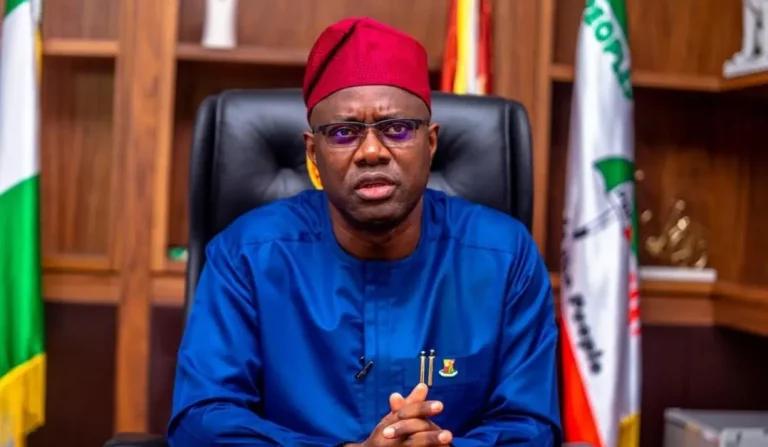


Seyi Makinde has voiced new concerns on Nigeria’s democratic trajectory, warning that the nation might be headed into a one-party regime.
Makinde noted in a newsletter titled “The business of governance” that opposition groups are gradually being marginalized and that people who oppose the notion of Nigeria being a one-party state are progressively being intimidated.
He also cautioned that the country seemed to be entering a phase characterized by apathy, disengagement, or silence, pointing out that this could lead “us in a direction we may later struggle to reverse.”
“I hope you are well despite the challenges in our dear country,” Makinde stated. Important questions are being raised by developments inside the African Democratic Congress (ADC) and the Peoples Democratic Party (PDP), as well as by recent stances adopted by the judiciary and INEC.
“These are not only political concerns; they affect everyone who has faith in the future of democracy in our nation.
“I also know that a lot of you are keeping a close eye on us as Oyo State enters a period of transformation. And that you have concerns about leadership, continuity, and our state’s future course.
As part of a thoughtful transition process, we have interacted with several reliable people, and I will eventually share a conclusion that takes into account both the advancements we have made and the future we need to protect.
Beyond this, though, I think there is a larger discussion about Nigeria turning into a one-party state that we cannot afford to overlook.
Because they believe their opinions are no longer important, some people have started to discreetly withdraw from discussions about our future.
Balance, the existence of reliable alternatives, robust institutions, and public trust in the process are all necessary for a functioning democracy.
Speaking out against Nigeria’s transformation into a one-party state is now openly threatened. Opposition is being pushed to the periphery, divided, or restricted.
“We shouldn’t discount this worry carelessly, regardless of whether we agree with it or not. Because accountability deteriorates when opposition becomes ineffectual.
“And the problems we face on a daily basis become more difficult to solve when the government is not held accountable.”
About The Author