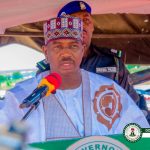
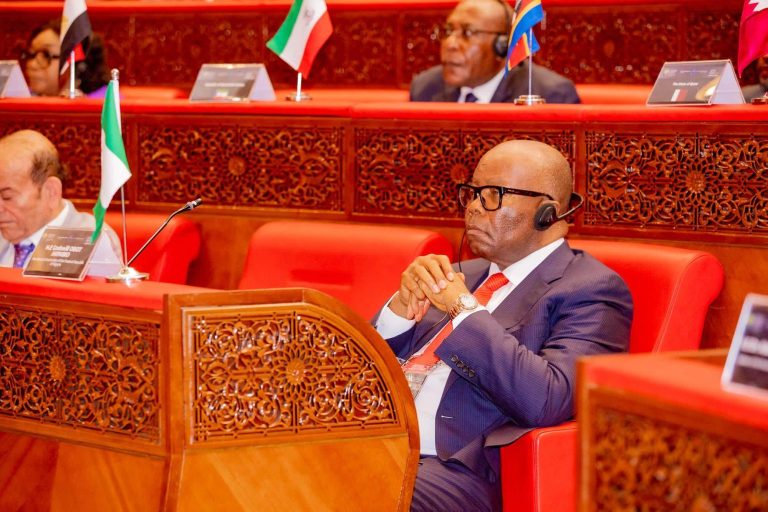


Nigeria cannot continue to export its raw minerals without adding value, according to Senate President Godswill Akpabio, who made this statement Tuesday at the first raw materials summit with the theme “Shaping the Future of Africa’s Resource Landscape.” Akpabio, who was represented by Senator Aminu Abbas, the chairman of the Senate Committee on Science and Technology, called for an end to what he called the colonial legacy of Africa supplying raw minerals while others innovate using the same raw minerals.
He underlined that the National Assembly is adamant on ending the practice completely with its 30 Percent Minimum Value-Addition Bill.
In order to stimulate domestic enterprise, generate jobs, draw in capital, and establish robust value chains that benefit our people, the previous governor of Akwa-Ibom clarified that the bill was not meant to suppress trade.
In keeping with this, I would want to reiterate our complete legislative support for the 30 percent Minimum Value-Addition Bill that is presently being considered. No Nigerian-origin raw material may be exported without first undergoing at least 30% local value addition, whether through processing, refining, packaging, or industrial transformation, according to this ground-breaking measure.
“This extractive model fuelled by colonial legacies and sustained by global asymmetries must now give way to a new paradigm rooted in local processing, regional integration, and sovereign economic vision.
“We must reject the historic pattern in which Africa merely supplies inputs while others reap the benefits of innovation, branding, and global market control. The future of Africa lies not beneath our soil but in what we do with what lies beneath. And what we do must be backed by law, driven by policy, and sustained by enterprise.
“Our task is to empower African entrepreneurs, SMEs, cooperatives, and young innovators who will turn mineral wealth into exportable machinery, agro-resources into packaged goods, and research into revenue.
“We invite African pension funds, sovereign wealth institutions, and multilateral development banks to direct capital into processing infrastructure, industrial parks, and green energy corridors linked to our raw materials.
“We are drafting laws to support climate-smart mining, regenerative manufacturing, and the circular economy. This is our commitment not as a gesture, but as a generational mandate,” he said.
On his part, the Minister of Innovation, Science and Technology, Uche Nnaji, said Africa would no longer send its raw minerals out of the continent.
Nnaji revealed that in order to improve intra-African trade under the African Continental Free Trade Area (AfCFTA), the ministry is implementing digital technologies, traceability infrastructure, and research-to-industry paths.
Africa goes from exploitation to transformation, from potential to wealth, in this manner. Let the message from this summit be clear: Africa will no longer export its future in its unadulterated state. Our harvests will provide the world’s markets, our minerals will fuel companies, and our young people will spur innovation,” he said.
About The Author