
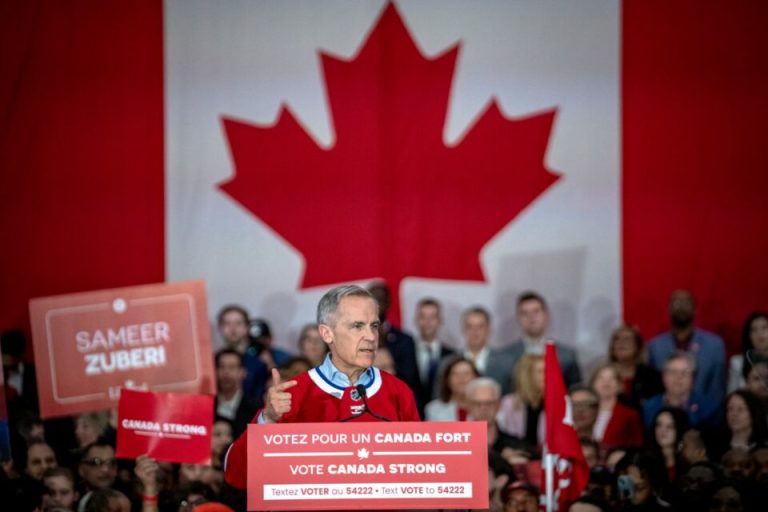


On Monday, Canada elects a new government to deal directly with President Donald Trump, whose trade war has characterized the campaign, and to face annexation threats from the United States.
Before the US president’s attacks on the nation caused a sharp reversal in polling predictions, the Liberal Party, led by new Prime Minister Mark Carney, appeared destined to lose handily to Pierre Poilievre of the Conservatives.
The 60-year-old Carney only took Justin Trudeau’s place as prime minister last month; he has never been elected. He had a lucrative career as an investment banker before serving as the central bank governor in both Canada and Britain.
Carney has argued his global financial experience has prepared him to guide Canada’s response to Trump’s tariffs.
In order to reduce Canada’s dependency on the United States, which Carney claims “we can no longer trust,” he has also pledged to boost domestic trade and increase Canada’s economic prospects overseas.
Throughout the campaign, Trump has claimed that the US “wants to break us, so they can own us.”
“Calm is what we need, not turmoil. In the last days of the campaign, Carney declared, “We need an adult, not anger.”
The 45-year-old professional politician Poilievre has attempted to maintain the focus on domestic issues, particularly rising living expenses, that caused Trudeau to lose significant support towards the end of his ten years in office.
The Tory leader has claimed that Carney would carry on what he refers to as “the lost Liberal decade,” contending that only a new Conservative government can address issues that Canadians consider important, like as housing shortages, crime, and other non-Trump-related concerns.
He declared over the weekend that “four more years of this is too much for you to bear.”
Despite criticizing Trump, Poilievre said that Canada was exposed to a hostile U.S. after ten years of subpar Liberal leadership.
“A good pick”
Despite predicting a close contest, final polls place Carney as the favorite.
Voters believe the former central banker is the best person to deal with Trump, according to numerous surveys.
According to Jeff Sims, who resides in Quebec close to Ottawa, Canada’s capital, Carney has “the pedigree” to be prime minister.
The 46-year-old told AFP on Sunday, “I think that’s a good pick, having two central banks under his belt.”
Janice Wyner denied that Carney was a break from Trudeau at a weekend Conservative event in the battleground city of Oakville, west of Toronto.
Trudeau’s “policies stunk and it’s the same party,” she told AFP.
“Canada is just in a mess. I’m 70 years old. It’s not even a country that I recognise and I’m worried for my grandkids.”
Like many voters, Nadine Sokol, a 41-year-old who also lives near Ottawa, listed “the threat coming from the US” as her “number one issue.”
– Historic turnaround –
If the Liberals win, it would mark one of the most of dramatic turnarounds in Canadian political history.
On January 6, the day Trudeau announced he would resign, the Conservatives led the Liberals by more than 20 points in most polls, and Poilievre looked on track to be Canada’s next prime minister.
But Carney replacing Trudeau combined with nationwide unease about Trump transformed the race.
Public broadcaster CBC’s poll aggregator on Sunday put the Liberals’ national support at 42.8 per cent, with the Conservatives at 38.8 per cent.
As with US elections, national polling numbers may not predict a result.
The performance of two smaller parties — the left-wing New Democratic Party (NDP) and the separatist Bloc Quebecois — will be closely watched.
In past elections, strong NDP performances in Ontario and British Columbia, and a good showing by the Bloc in Quebec, have curbed Liberal seat tallies, but polls suggest both smaller parties could be facing a setback.
Nearly 29 million of Canada’s estimated 41 million people are eligible to vote. A record 7.3 million people cast advanced ballots.
In the massive G7 country which spans six times zones, polls open at 8:30 am local time in the Atlantic province of Newfoundland and Labrador.
Canadians will elect 343 members of parliament, meaning 172 seats are needed for a majority. The Liberals won a majority in 2015 but have governed with a minority since 2019.
About The Author