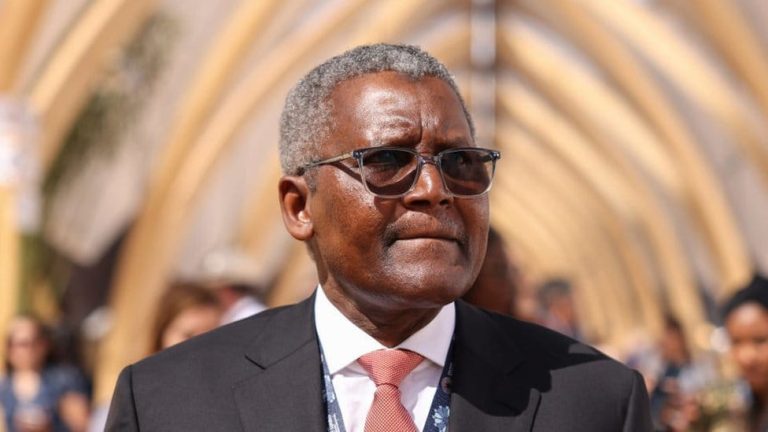


International oil corporations operating in Nigeria are reluctant to sell crude to Dangote Refinery. The refinery has expressed worry about this, claiming that their preference for selling crude to traders causes it to repurchase at higher costs, which has wider economic ramifications. Even if the naira-for-crude effort has improved supply, Aliko Dangote, President/Chief Executive of Dangote Industries Limited, revealed this when hosting the bridge the gap in crude supply by imports from the United States and other African producers. Dangote praised the Nigerian National Petroleum Company Limited (NNPCL) in a note on Tuesday for boosting crude deliveries to the refinery in March, pointing out that volumes increased to 10 cargoes—six in naira and four in dollars—to improve domestic gasoline availability.They handed us four shipments in dollars and six cargoes in naira last month,” he stated. In order to lessen the effects of the crisis, he continued, the refinery has transported roughly 17 cargoes of gasoline to African nations, using its 650,000 barrels per day capability to stabilize supplies across several regions. Dangote remarked, “What I can do is the capacity to supply them.” In order to ensure long-term energy and food security throughout the continent, Dangote continued, the refinery is looking for more access to domestically priced crude under local currency. According to Daily Trust, in order to lower the cost of the commodity locally, certain parties have argued for a separate agreement for Dangote to obtain crude supply at a regulated price.Bismark Rewane, a well-known economist, recently promoted a refinery-based subsidy plan that directly helps consumers. According to Rewane, the suggested approach would guarantee that refined petroleum products are offered to consumers at reduced prices while the government supplies domestic refiners with crude oil at a controlled price. Analyst: Why IOCs are unable to sell directly to Dangote However, Dr. Marcel Okeke, an economist and analyst of the oil and gas sector, told Daily Trust that the IOCs in Nigeria are subsidiaries of multinational corporations, making it challenging to support the local refiners given the current product sharing arrangement and the advanced crude oil sale by the Nigerian government.He said that market forces govern the crude oil market, which is an open market.
Okeke stated, “For example, if the federal government has sold what they should get, for example, upfront because you know some of it was used to obtain a loan, who should dictate to them who they should sell to when the federal government takes what should be their share and the IOCs take what should be their share? IOCs are, after all, a subsidiary of a multinational corporation someplace.
“If you refer to something like Shell, Shell in Nigeria is a part of the global Shell headquarters somewhere.”They will therefore advise them to bring their own portion and allow us to sell on the global market. What other authority does the government have because it has seized its own, which he has either sold or utilized up front? That’s what I believe is happening. Alright?
“What they do not own is beyond their control. Furthermore, this liberalization, whatever. Who should rule over whom if it has been genuinely liberalized? Why? Thus, the market is open. The market is open. Additionally, supply and demand drive an open market.Therefore, the government cannot force people to sell where they may receive the highest price. If the President is the Minister of Petroleum Resources, then let him make a presidential order in that regard. However, he is unable to. That’s how I see it.
Dangote stated that in order to boost agricultural output and alleviate supply bottlenecks, the corporation has increased fertilizer shipments.
“The challenges are numerous,” he stated. One of our fertilizers is urea. He remarked, “I believe that over the past few days, we have been loading to mostly African countries, which we were not doing before.”
He continued, “And now it has to do with petroleum products, which we are now sending mainly to African countries.”In an effort to control gasoline prices and improve long-term energy and food security throughout the continent, Dangote continued, the refinery is looking for more access to domestically priced crude under local currency agreements.
Speaking, Amina Mohammed, the UN’s Deputy Secretary-General, emphasized the strategic significance of Dangote Industries Limited, especially Dangote Fertilizer Limited, in tackling Africa’s growing food security issues and urged more robust international collaborations to expand its influence.
She described Dangote’s integrated industrial model as a crucial pathway and stated that the UN would prioritize amplifying scalable solutions capable of reducing the continent’s food crisis.”I think the UN’s job here is to amplify and to put visibility on the possibilities of mitigating a food security crisis, and this is one of them,” she continued. “I hope we can continue to engage partners and countries that should collaborate with Dangote Industries when we return.”
About The Author