
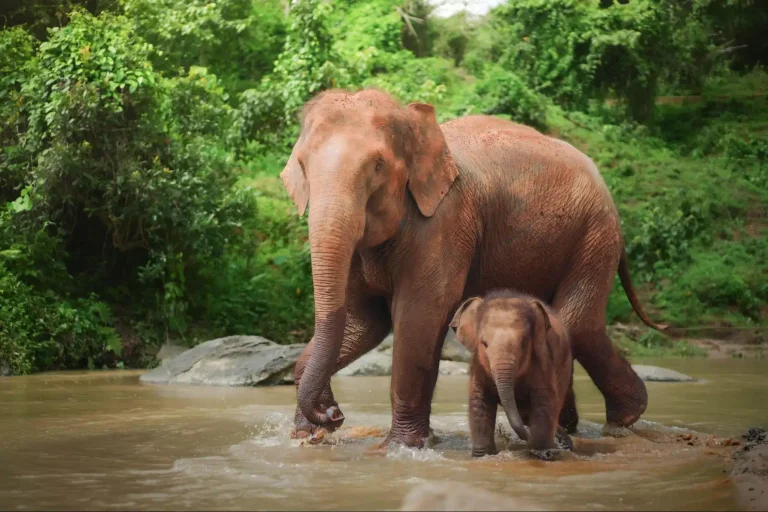


An weary wildlife caretaker makes milk formula for Agbaibor, a month-old orphaned forest elephant that was saved after venturing out of the rainforest by himself, as morning breaks over Okomu National Park in Ovia South-West Local Government Area, Edo State.
Joshua Aribasoye, one of the people in charge of feeding and keeping an eye on the calf in a temporary cage at a ranger outpost inside the park in southern Edo, stated, “The baby elephant has to take two liters of this per meal.” Agbaibor, named for the ranger who assisted in his rescue, was discovered late last year near a palm oil plantation bordering the protected forest after being separated from the herd. Rangers and conservationists attempted to reunite the calf with its family by taking it back into the forest, but it soon wandered out again. Fearing that the animal would die alone or be attacked, park authorities and conservation group African Nature Investors (ANI) launched an emergency effort to nurse the animal, flying in elephant rehabilitation specialists from Zambia and assigning caregivers to raise him.
It is now an expensive operation. ANI spends four to five million naira (about 3,600) a month on his care, which includes oats, nutritional vitamins, and 77 kilograms of milk powder. The recovery process is expected to take an additional three to five years, according to conservationists. Before the calf is eventually reintroduced, it will be gradually exposed to the noises and movements of wild herds in a new enclosure being built deeper within the park, within elephant habitat.
“There, the calf will receive care. Peter Abanyam, project manager at ANI, stated, “Until it is integrated into a group.”
There are still 200.
Forest elephants are classified as severely endangered by the International Union for Conservation of Nature (IUCN), with conservationists predicting that there are only about 200 left in the nation.
Okomu, which covers around 24,000 hectares and is one of Nigeria’s last remaining rainforest habitats, is thought to be home to about 40 people.
“Okomu is essential to Nigerian conservation,” stated Abanyam.
“Housing forty elephants is a huge number in a small ecosystem like this, and it needs to be protected at all costs.”
However, the forest is under increasing threat.
Large portions of the reserve have been divided by logging, poaching, farming, and growing human settlements, which has reduced elephant corridors and increased interaction between local populations and animals.
Before being hired by ANI as a ranger, Godstime Christopher, 26, assisted in the removal of illegally harvested timber from the forest.
He now works with the organization’s biomonitoring team, tracking elephant movements and identifying poachers using camera traps.
He acknowledged, “I thought I would use that to exploit logging when I became a ranger.” However, the training altered our perspective.
Keep what we have.
In one of Africa’s fastest-growing nations, where economic hardship frequently pushes people farther into protected forests in search of land, timber, or bushmeat, conservation organizations say involving local populations is crucial if endangered wildlife is to survive. Christopher cautioned that although the ranger program seems to have reduced poaching in the area, hunting for other species still upsets the elephants and damages their habitat.
Back at the rehabilitation facility, Agbaibor drinks from large bottles of milk formula, splashes in the dirt, and prods his handler for attention.
The hard labor has become quite personal for Aribasoye.
He stated, “We are meant to be like a mother to him.”
I’m happy to see him eating and playing since I know we’re trying to save what’s left.
AFP
About The Author