
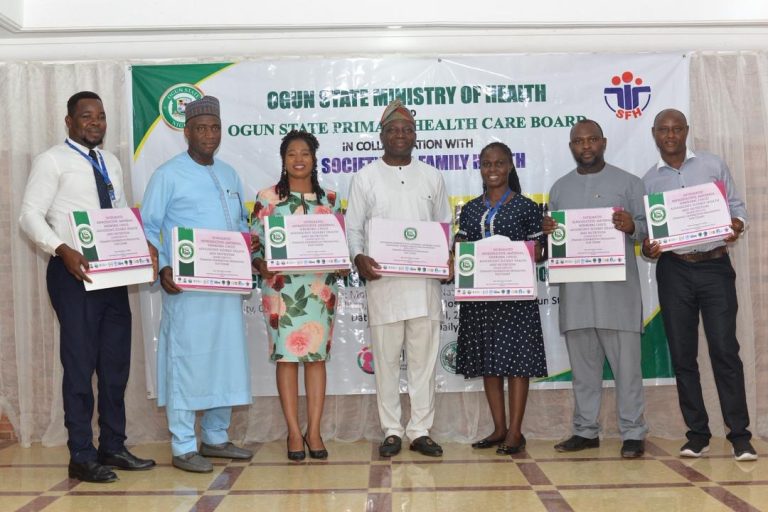


The First Integrated Reproductive Maternal Newborn Child Adolescent Elderly Health and Nutrition (RMNCAEH+N) demand generation health facility flip chart was introduced by the State Government of Gun in collaboration with the Society for Family Health.
The goal of the chart is to improve health communication and service delivery throughout the state’s facilities and communities.
Speaking during the official inauguration and distribution on Monday, Dr. Elijah Ogunsola, Executive Secretary of the Ogun State Primary Health Care Development Board, characterized the project as a strategic instrument for improving client-centered care and informed health decision-making.
The flip chart is a useful and user-friendly tool created to assist healthcare professionals and community mobilizers in providing clear, accurate, and consistent health information, according to Ogunsola, who was represented by Dr. Thomas Solarin, Director of Disease Control and Immunization.
According to him, the technology offers crucial health messages in an easy-to-understand graphic style that improves counseling quality and fosters improved health outcomes in a dynamic health system where communities rely on reliable sources of information.
Ogunsola praised development partners for helping to make the project a reality and for creating what he called the first health promotion handbook that could be used in both community and facility settings.
Additionally, he expressed gratitude to Tomi Coker, the Commissioner for Health, for fostering a supportive atmosphere and reiterating the government’s dedication to developing a more adaptable, people-centered healthcare system.
Dr. Anthony Nwala, Coordinating Director of the Society for Family Health’s RMNCAEH+N Programme Delivery Unit, reiterated the organization’s dedication to enhancing healthcare delivery through its Delivering Innovation in Self-Care (DISC) Project.
According to Nwala, the project also aims to increase the demand for health services by using community-driven tactics like outreach, community orientation, male engagement, and interpersonal communication.
Mrs. Goodness Ojo, speaking on behalf of the World Health Organization (WHO), praised the teamwork and leadership behind the evidence-based tool, pointing out that it would improve health education, assist frontline staff, and empower communities.
About The Author