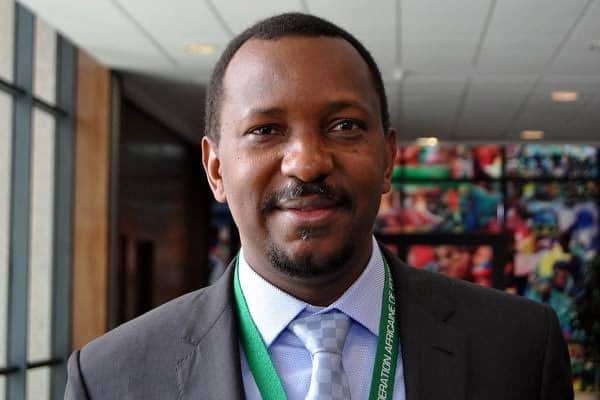


Shehu Dikko, the Chairman of the National Sports Commission, emphasized that Nigeria has more stadiums than any other African country and urged state governments to collaborate in revitalizing sports venues nationwide.
Shehu Dikko confirmed that, despite the numerous stadiums located throughout Nigeria, only one has received approval for international matches. If the Godswill Akpabio International Stadium in Uyo, Akwa Ibom State becomes unavailable, Nigeria may have to host home games abroad.
Dikko made this remark on a radio show led by ex-Nigerian professional Segun Odegbami on Eagle 7 Sports Radio 103.7 FM.
The sports commission chairman said: “There is only one stadium in Nigeria that currently meets international standards to host top-tier competitions. If, for any reason, it becomes unavailable, Nigeria would have to play international matches abroad.
“Yet, no country in Africa has as many stadiums as we do. They are spread across the country but are either abandoned or poorly maintained.”
Dikko highlighted that the increasing reliance on synthetic pitches has hindered the progress of athlete development, as quality surfaces are essential for cultivating talent.
He described his commission’s initiative to revitalize sports infrastructure as a three-pronged strategy: “Reset, Refocus, and Reload.” The ‘Refocus’ aspect aims to ensure intentional and deliberate improvements, with plans to enhance the sports budget and start the project at Abuja Stadium.
To aid this effort, the government has partnered with international stadium experts who have extensive experience with prominent facilities such as the San Siro, Juventus Stadium, and Real Madrid’s ground.
This team is expected to arrive in Nigeria by May 12 to evaluate existing stadiums and develop a practical plan based on available resources.
Dikko stressed the significance of drawing lessons from effective maintenance practices at premier venues around the globe. He stated, “We are eager to work with global experts and local talents to restore our sports infrastructure, starting with pitch quality.”
The aim is to set up at least one stadium that meets international standards in each of Nigeria’s six geopolitical zones. Once this is achieved, attention will turn to smaller venues and collaboration with the private sector to create functional pitches in schools and communities.
Furthermore, Dikko spoke about the impact of foreign football, emphasizing that public officials should balance their admiration for international clubs with support for local teams.
He stated, “It is acceptable to support a foreign club privately, but as a public official to promote it—particularly while ignoring local teams—harms our development. I used to be a follower of Manchester United, but I stopped. Back in 2008, when we brought them to play in Abuja, I recall that we raised more than £2–3 million for that match. They played and went away. Then I questioned myself about what we had gained. It marked a turning point.
After that, I took on the role of promoting domestic football. In my capacity as league chairman, I implemented fines for officials who donned foreign jerseys. Supporting global football is fine, but we must never elevate it above our domestic programmes.”
About The Author