
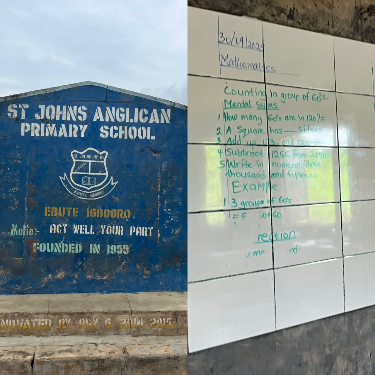


The agrarian community of Ebute-Igbooro, a 150-year-old settlement on the border between Nigeria and the Benin Republic, is characterized by severe underdevelopment, with residents pleading for basic social amenities, educational upgrades, and economic opportunities.
State of Schools and Water Scarcity
The poor condition of educational infrastructure is highly visible. At St. John’s Anglican Primary School, which has 242 students, instructional materials are makeshift; a systematic arrangement of 40 ceramic white tiles serves as the marker board. The school features a mix of a seven-classroom block (one of which is unpainted, cracked, and crumbling) and an uncompleted structure with a palm-thatched roof. Some children attend school barefoot, lacking uniforms, bags, and textbooks. Although the school has a well, a local source confirmed students lack access to portable water and pleaded for boreholes and a fence to protect the property from hoodlums.
A former student and the state chairman of the Association of Senior Civil Servants, Issa Olude, disclosed that some of the school buildings are over 100 years old, having been constructed by the colonial masters.
A visit to another facility, Yewa North Local Government Primary School (with 210 pupils), revealed students resort to open defecation because the school currently only has two toilets being built, which are said to be for teachers. A school source simply replied “the bush” when asked where pupils relieve themselves, noting the urgent need for a separate pupil toilet, as well as computers, renovation, and fencing.
Community Needs and Economic Hardship
The community’s history dates back to 1875, and its residents primarily speak the Yoruba Ketu dialect, engaging mainly in farming, with women supplementing income by producing fufu, garri, and petty trading. The effects of economic hardship are starkly evident in the community.
Residents, including 41-year-old mother of four Ademola Muyinat, expressed their concerns:
* Education: The existing schools are insufficient and need expansion and reconstruction, particularly the lack of toilets.
* Healthcare: The community lacks a primary healthcare center and depends on a general hospital that requires enlargement and lacks essential beds and toilets.
* Water: Resident Kabirat Bunmi noted that the community depends entirely on wells and rivers for water and appealed for government intervention to provide healthy, potable water.
* Economy & Infrastructure: Bunmi added that to sell their produce (like garri and tomatoes), they must travel to Lagos since they do not have a market in Ebute-Igbooro.
The Olori Odo (head of youths), Emmanuel Akeem, highlighted the need for financial and industrial infrastructure, specifically calling for banks (as residents must travel to Ilaro for banking) and factories or companies to provide jobs for the youth, who currently rely on fishing and motorcycle riding. He also requested the reconstruction of the old road leading to Oja Odan.
Monarch’s Appeal and Government Response
The Elebute of Ebute-Igbooro Kingdom, His Royal Highness, Oba Amusa Adetunji Dosunmu (Isolo 1), who became the first monarch in 2018, urged the state government to address the kingdom’s needs, lamenting that despite its long existence, it lags significantly in development. The monarch thanked the government for previous efforts but called for development that will benefit future generations, specifically listing the need for a market, school renovations, a town hall, banks, a tiled road linking the town to the city, and firms to employ youth.
When contacted, the State Commissioner for Education, Science and Technology, Prof. Abayomi Arigbabu, was unable to confirm the status of the schools immediately but requested and received the school details, though a response was still awaited at the time of reporting.
About The Author