
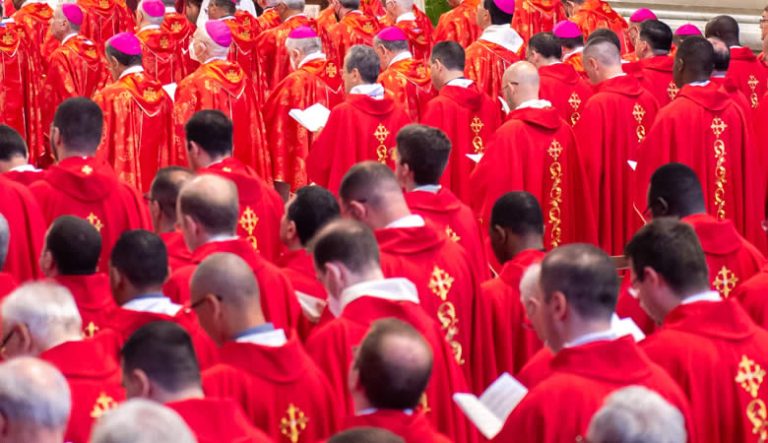


Following the passing of Pope Francis, red-robed cardinals were scheduled to choose a date on Monday for the conclave that would choose a new leader for the 1.4 billion Catholics worldwide. There is growing suspicion that the covert election process could start on Monday, May 5, the day after the nine days of official Vatican mourning conclude. Dozens of so-called “Princes of the Church” convened at the Vatican at 9:00 am (0700 GMT). Only 135 of the Church’s 252 cardinals are under 80 and can vote for a new pope, but they were summoned back to Rome after Francis’ death on April 21. Many of them are strangers, and they come from all over the world.
However, they already met four times last week for what are known as “general congregations,” where they started to get to know one another. There was a “beautiful, fraternal atmosphere,” according to Cardinal Gualtiero Bassetti, 83, a former chairman of the Italian bishops’ conference. He told the Italian newspaper Corriere della Sera that there might be some challenges because there have never been so many voters and not everyone knows one another. There aren’t many hints as to who they might pick yet. In an interview published on Sunday, Spanish Cardinal Jose Cobo told El Pais, “I think that if Francis has been the pope of surprises, this conclave will be too, as it is not at all predictable.”
Following Francis’ decision to be buried outside the walls of the Vatican, 400,000 people came to St. Peter’s Square and beyond on Saturday for a funeral and burial ceremony. The “pope of the poor,” Italian Cardinal Pietro Parolin, who served as Francis’ secretary of state and was the pope’s number two, is widely regarded as the favorite to succeed him. British bookmakers William Hill placed him just ahead of Filipino Luis Antonio Tagle, the Metropolitan Archbishop emeritus of Manila, as well as Ghana’s Cardinal Peter Turkson.
As a Filipino, Ricardo Cruz, 44, a data and artificial intelligence specialist, expressed his desire that the next pope will come from Asia, but as a Catholic, he simply hoped the cardinals would choose the “right pope.” Cruz visited Francis’s tomb on Sunday. Francis was widely admired and respected for his efforts to make the Church more compassionate, but some of his changes infuriated the conservative side of the Church, especially in Africa and the United States.
Roberto Regoli, a professor of Church history and culture at the Pontifical Gregorian University in Rome, told AFP that the cardinals would be looking “to find someone who knows how to forge greater unity”.
“We are in a period in which Catholicism is experiencing various polarisations, so I don’t imagine it will be a very, very quick conclave,” he said.
Bassetti, who is too old to participate, however said he thought it “will not be long”.
Some 80 percent of the cardinal electors were appointed by Francis — though that is no guarantee they will pick a successor in his likeness.
Most are relatively young, and for many it is their first conclave.
– ‘We need a courageous leader’ –
The vote, held in the Sistine Chapel with its 16th-century ceiling frescoed by Michelangelo, is highly secretive and follows strict rules and ceremonial procedures.
The process could take several days, or potentially longer.
Until one candidate receives a two-thirds majority, there are four votes cast each day: two in the morning and two in the afternoon. Europeans make up less than half of the voting population. “The future pope needs to love all continents and have a universal heart.” Cardinal Dieudonne Nzapalainga of the Central African Republic told the Italian newspaper Il Messaggero, “We must look at what is proposed, not at color or origin.”
About The Author