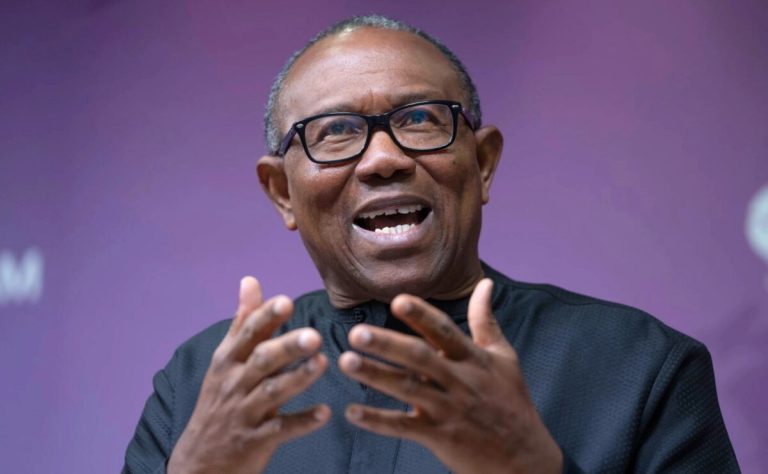


The former governor of Anambra State and presidential candidate of the Nigeria Democratic Congress (NDC), Mr. Peter Obi, has questioned the Federal Government’s borrowing practices, claiming that the significant rise in national revenue under President Bola Tinubu’s administration has not resulted in better living conditions for Nigerians.
In response to the President’s recent evaluation of his administration’s performance following three years in power, Obi made the comments in a message that was published on his official Facebook.
Obi claims that one of the administration’s greatest accomplishments was the rise in government revenue from N16.8 trillion in 2022 to N35 trillion in 2025.
Obi contended that the nation’s debt profile had continued to rise in spite of the claimed increase in revenue.
Obi said, “It’s shocking that Nigerians anticipated a decrease in borrowing with the exponential increase in revenue, but the opposite is the case.”
He claims that Nigeria’s overall public debt has increased by more than N100 trillion over the past three years, reaching roughly N200 trillion.
Obi also contended that the nation’s earnings around that time exceeded budgetary projections because of international and
national economic events that have an impact on government revenue and commodity prices.
Additionally, Obi said that at that time, important socioeconomic indices had gotten worse.
“Alarmingly, nearly all important socio-economic and governance indicators are worse than in 2023, despite the astronomical increase in both revenue and debt,” he stated.
Obi listed declining GDP per capita, increased multidimensional poverty, and unemployment as issues of concern.
He claims that the number of people living in multidimensional poverty rose from over 87 million in 2023 to over 140 million in 2025.
“Where did all the money go?” is the question that Nigerians and even the world community are asking. Obi said He urged the government to provide Nigerians a thorough explanation of how revenues and borrowed cash have been used since 2023 and asked for increased accountability and transparency in the administration of public resources.
About The Author