
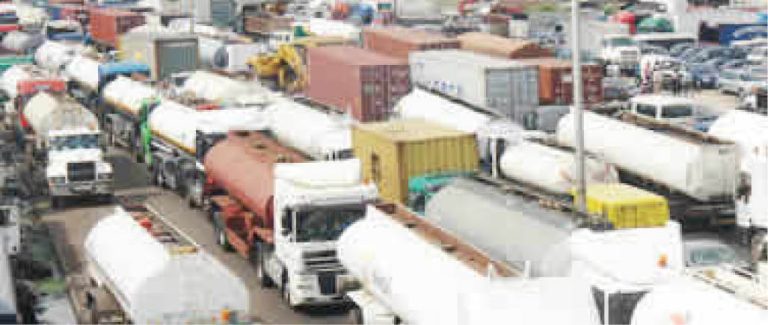


Nigerians spent at least N5.43 trillion on Premium Motor Spirit (PMS), or fuel, in the first three months of 2026 as they continue to struggle with the high cost of petroleum products due to the removal of fuel subsidies and the US-Iran war.
The Nigerian National Petroleum Company Limited (NNPC) and marketers have import permits issued or renewed by the Nigerian Midstream and Downstream Petroleum Regulatory Authority (NMDPRA), and the Dangote Petroleum Refinery filed a lawsuit asking the court to invalidate these permits. This comes amid a new crisis in the downstream petroleum sector.
In response to the new lawsuit, the Depot and Petroleum Products Marketers Association of Nigeria (DAPPMAN) defended the NMDPRA’s ongoing issuance of fuel import licenses yesterday, stating that the action is still essential to the nation’s energy security.
In the midst of the ongoing crisis, Daily Trust’s examination of the National Bureau of Statistics’ (NBS) monthly petrol prices and the NMDPRA’s monthly factsheet revealed the startling amount of money Nigerians spent on PMS in just the first three months of 2026.
The price and PMS consumption may be higher because both reports’ analyses relied on average pricing.
Out of the 4,878,400,000 (billion) litres of PMS used during the quarter, N5.43 trillion was spent on fuel. This included both the imported product and the fuel that the Dangote Refinery sold locally.
Based on the average price of N1,034.76 that the NBS stated the commodity cost during the month, a breakdown revealed that 1,866,200,000 (billion) litres of PMS were consumed in January, translating into N1.93 trillion
At a rate of N1,051.47 per litre, consumption fell to 1,593,200,000 (billion) litres in February, totalling N1.67 trillion.
Although the amount decreased to 1,419,000,000 (billion) litres in March, N1.82 trillion more was spent on the product. This illustrates the product’s high cost during the month due to the rise in crude oil prices during the height of the US war on Iran.
The average cost of PMS during the month rose to N1,288.54, according to the NBS.
The N5.43 trillion spent on the commodity was 3.04 percent less than the N5.60 trillion spent in the preceding quarter of Q4 2025.
5,319,400,000 (billion) litres of PMS were consumed in Q4 2025, according to an analysis, and 1,757,700,000 (billion) litres were consumed in October, totalling N1.84 trillion at N1,052.31 per litre.
Nigerians paid N1.68 trillion, or 1N1,061.35 per litre, for 1,587,000,000 (billion) of the product in November.
Due to the holiday season, 1,974,700,000 (billion) litres were consumed in December, and N2.07 trillion, or N1,048.63 per litre, was spent on the product.
New Dangote/Marketers’ row
Despite having a 650,000 barrel-per-day refinery, the Dangote refinery has long disapproved of major marketers’ continued importation of petroleum products, claiming it can meet the country’s needs.
Marketers maintain that the refinery is still unable to meet the country’s demand.
The refinery filed a new lawsuit against the Attorney General of the Federation on Friday in an attempt to revoke fuel import licenses given to Nigerian National Petroleum Company (NNPC) Limited and soil marketers.
About a year had passed since the refinery withdrew a previous lawsuit contesting comparable import permits granted to the state oil company and a number of fuel dealers.
Dangote filed the new lawsuit before the Federal High Court in Lagos, claiming that the approvals went against a previous court ruling that required all parties to keep things as they were.
The refinery claimed in the lawsuit that licenses given to certain marketers this month endanger its operations and violate legal provisions that only allow fuel imports when domestic supply is insufficient to meet national demand.
However, DAPPMAN retaliated yesterday, stating that the import licenses at issue are not administrative courtesies.
These are the legal tools that Nigeria’s fuel supply chain uses to operate. They were issued by a body with the authority to make precisely this kind of decision under a regulatory framework created by the Petroleum Industry Act.
According to DAPPMAN, “the NMDPRA has consistently maintained, correctly, that these licenses exist to protect supply security, not to disadvantage any single producer, however large.”
Based on the validity, legality, and durability of their operating licenses, the association claimed that its member companies had invested billions of naira in depot infrastructure, logistics networks, and compliance systems.
The association stated that “a legal action designed to retroactively void those licenses does not just affect individual businesses, it introduces uncertainty into the entire downstream supply chain at a moment when Nigeria can least afford it.”
The “premise that a private refinery’s commercial interests should override a regulatory authority’s mandate to ensure adequate supply to Nigerian consumers” is unacceptable, according to DAPPMAN, even though it respects Dangote Petroleum Refinery’s right to seek legal remedies.
The PIA makes it clear that import licenses may be granted in situations where the regulator deems it necessary. That decision has been made. It has previously been defended in court. It ought to be defended once more, it continued.
A source in Dangote who spoke with our correspondent last night said the suit was directed to the AGF and not the marketers. He declined further comment on the position of the marketers.
About The Author