
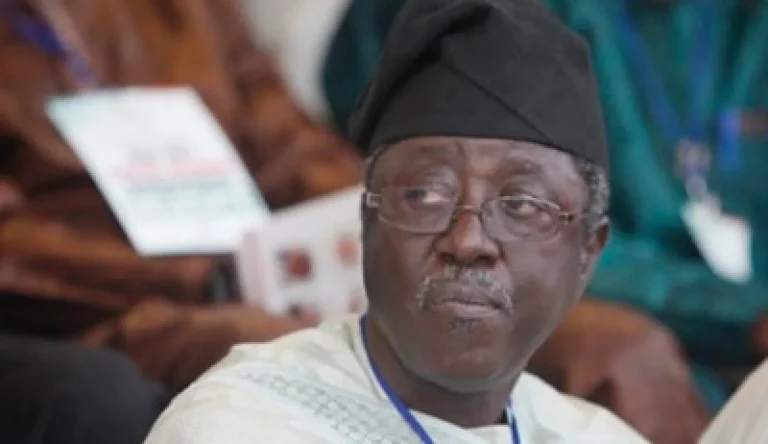


Former Governor Jonah David Jang has come under fire from the Plateau State branch of the Kautal Pulaaku Fulbe Association of Nigeria (KPFAN) for opposing a recent court decision that granted indigeneship to Hausa people in Jos North Local Government Area based on their place of birth and length of residence in the state.
Jang responded to the decision in a statement on Saturday, stating that it would have a significant impact on the state’s identity, cultural legacy, and indigenous rights.
The former governor said that questions about citizenship, residency, and indigenship in the state had dominated political and social discourse for decades and questioned why the court should make a snap decision on a topic that would exacerbate tensions.
He maintained that changing the current structure could lead to conflict and jeopardize the rights of those who have historically been acknowledged as indigenous to the state.
However, the Fulani group responded to the elder statesman in a statement released on Sunday by its National Publicity Secretary, Haruna Idris Bayero, characterizing his objection to the decision as not only regrettable but also hazardous to the state’s precarious peace and unity.
According to Bayero, Jang’s position violates the Nigerian Constitution’s guarantees of equal rights for all citizens and its ban on discrimination based on religion, ethnicity, or place of origin.
The recent comments made by former Plateau State Governor Senator Jonah David Jang rejecting the issuing of indigene certificates to Hausa/Fulani inhabitants in Plateau State are viewed with complete dismay and regret by the Kautal Pulaaku Fulbe Association of Nigeria (KPFAN), according to a statement.
Bayero went on to say:
In addition to being regrettable, his stance is a perilous remnant of ethnic prejudice that runs counter to the Federal Republic of Nigeria’s Constitution (1999, as amended).
Senator Jang’s position contradicts Section 42 of the Nigerian Constitution, which forbids discrimination based on religion, ethnicity, or place of origin.
Every Nigerian citizen has the right to be acknowledged as a legitimate citizen of the state in which they reside, make contributions, and pay taxes, including Hausa/Fulani families that have lived in Plateau State for generations—some for more than a century. Citizenship cannot be granted on the basis of local allegiances.
Over the years, the indigenous-settler divide has been used as a weapon to marginalize other Nigerians. Numerous Hausa/Fulani communities in the Plateau were born there, have ancestral tombs there, and have made significant contributions to the state’s economy, security, and cultural life. It is a historical injustice to deny them credentials solely because their great-grandparents moved before the state was established.
The fact that Plateau State has seen recurrent cycles of violence is no longer news. Our association is adamant that recurring disputes have been sparked by the failure of previous Plateau leaders, including Senator Jang, to embrace justice and equality for all citizens, regardless of ethnic background.
“When a segment of society
“No contemporary society in the twenty-first century progresses by preventing fellow citizens from obtaining certificates of affiliation. If Jang’s reasoning were to be applied everywhere, the Nigerian federation would fall apart. We urge him to advocate for inclusion rather than exclusion using his old age and experience. In Plateau, the Fulani are not outsiders; they are neighbors, farmers, herders, traders, and, in many cases, indigenous people whose history predates Plateau State’s establishment in 1967.
We urge the Plateau State government to reject Senator Jang’s outdated recommendations and instead work toward a cohesive residency-and-indigeneity framework that upholds the Nigerian Constitution. Because of their ethnic surname, no citizen should be excluded from state-level rights, such as work, education, or political involvement.
Senator Jang’s remarks are a flagrant insult to the Hausa/Fulani populations who have lived on the Plateau for many generations and a disservice to national unity. In the event that legal action is required, the Kautal Pulaaku Fulbe Association will continue to oppose all sorts of discriminatory policies. We implore Plateau leaders to take a lesson from the past: justice, not ongoing marginalization, is the source of peace.
About The Author